Wind the clock back twenty years or so, and you’d find me trying to bash out a novel. It was a dystopian number called Embryo Song that owed more than a little to Margaret Atwood’s The Handmaid’s Tale. I managed 50,000 words (about 200 pages) before I ran out of ideas and energy and now, looking back, can recall almost nothing about it, not even the plot which says it all, really.
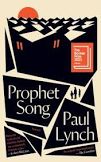
I remember, though, being pleased with the title, which I thought sounded edgy and original. I was wrong about that, too. There are a surprisingly large number of novels with the word ‘song’ in the title (325 according the Good Reads – although I’d take that number with a pinch of salt). Prophet Song by Paul Lynch is the latest.
Lynch’s novel has itself drawn comparisons with The Handmaid’s Tale and with George Orwell’s Nineteen Eighty Four. Set in Ireland, it envisages a future where, in response to an unspecified “ongoing crisis”, the government enacts an Emergency Powers Act that effectively suspends the constitution. Despite “outrage all over Europe” the regime quickly becomes “a monster”, with all opposition or dissent brutally dealt with by a new “secret police” force, the Garda National Services Bureau (GNSB).
The story begins when two GNSB plainclothes detectives call at Eilish Stack’s house, asking for her husband, Larry. Larry is deputy general secretary of the Teachers’ Union of Ireland (TUI) and is organising industrial action, which the government wants stopped. On the day of the strike, the TUI’s “democratic march” is broken up by “police with batons, they are beating the marchers into grovelling shapes…a teacher being dragged by plainclothesmen towards an unmarked car”. When Eilish rings Larry’s mobile there is no answer; when she tries it again the phone is off.
As the country descends into hysteria, totalitarianism, and rebellion, Eilish struggles to get justice for Larry, protect her four children, Mark, Molly, Bailey and baby Ben; and care for her increasingly senile father, Simon.
Except, except…I’m not sure struggle is the right word. It suggests something forceful and violent, whereas Eilish procrastinates. More than that, on occasion she is so self-delusional that I really struggled to warm to the character. For example, at one point her part of the city, her street, is the scene of fighting between the military and rebel forces. “She wakes to the sound of war come like some visiting god, a hammering fury that brings out a hammering in her heart…”…yet she still instructs Molly and Bailey to get ready for school. (Bailey sensibly points out that schools won’t be open “with all this going on”). I mean, I’m all for trying to keep things as normal as possible for your children but proposing to send them out into a warzone? Really?
It possibly doesn’t help that Lynch uses no speech marks to show when someone is speaking. It makes direct speech less punchy and it can be hard to work out who is speaking (or if anyone is) – although this did get easier as got used to the writing style.
Maybe it’s a genius-stroke on Lynch’s part, though. The lack of inverted commas does give the writing a dream-like quality which mirrors Eilish’s wilful (wishful?) inaction, which in itself is kind of the point. How do you know how to act when nothing seems real anymore? As a character says near the end of the book “I don’t see how free will is possible when you are caught up in such a monstrosity, one thing leads to another until the whole damn things has its own momentum and there is nothing you can do”.
Prophet Song hits its mark. It’s a stark reminder that the freedoms we take for granted in the West are fragile and could be lost in a heartbeat. The book’s ending is chilling…and grimly inevitable. Prophet Song won the 2023 Booker Prize.
Rating: ** Worth reading.
 whatcathyread