A few years ago, finding a scrap of paper on which my father had written his mother’s maiden name, I resolved to find out what had happened to my father’s parents. Evenings would now be spent on genealogy sites searching online records. I requested copies of birth, marriage and death certificates from the GRO, military records from the MOD and my father’s admissions history from Barnardo’s. I even read books on military and social history to help imagine what it was like for them and flesh-out the dry bones of facts and dates.
The process took three years, on and off. During that time there were moments when I asked myself why I was doing it. What was the point? My father and his parents were all long dead. Why spend so much time and money unpicking the past?
In Part Three of Bird Song, Elizabeth Benson settles the question for me. “…she had become intrigued by her mother’s parents…Her life had reached an age at which she should no longer be the last to die; there ought to be someone younger than her, a generation of children who should now be enjoying that luxurious safety of knowing that grandparents and parents still lay like a barrier between them and their mortality. But in the absence of her own children she had started to look backwards and wonder at the fate of a different generation. Because their lives were over she felt protective; she felt almost maternal towards them.
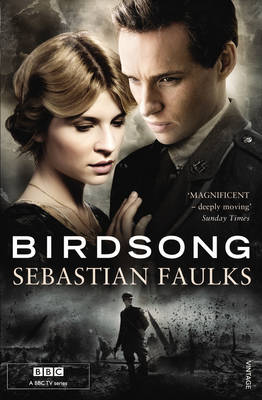
Bird Song begins in France in 1910. A twenty-year-old Englishman, Stephen Wraysford, is sent by his employer to the city of Amiens on the river Somme to learn about textile manufacture from Monsieur Azaire, and loses himself in a passionate affair with his host’s wife, Isabelle.
Part Two is set in France in 1916, in the trenches on the French-Belgian border. Stephen is now Captain Wraysford, “promoted from the ranks because he had a better education than most of the others and because those of the university subalterns who were not dead had taken on companies”.
Part Three moves to England in 1978. Elizabeth Benson reads a newspaper article about the sixtieth anniversary of the Armistice that “seemed to touch an area of disquiet and curiosity.”
For the rest of the novel, we flip between France 1917 / 1918 and England 1978 / 1979. The story is fairly simple: boy meets girl, boy fights in war etc…I can’t say more or I’d give away the plot. But Faulks’s writing is sublime. He takes us to the heights of all-consuming erotic passion and to the depths of meat-grinder tactics in the mud of the trenches – all the more tragic because we know it’s true. (My mother’s father survived the carnage of Ypres but wouldn’t speak about what he’d seen, just as Stephen won’t: “I do not know what I have done to live in this existence. I do not know what any of us did to tilt the world into this unnatural orbit…When it is over we will go quietly among the living and we will not tell them…We will seal what we have seen in the silence of our hearts…”)
This is possibly the most powerful novel I’ve ever read. You might argue the ending is a tad sentimental – but you’d have to have a heart of stone not to be moved.
Birdsong was named as one of Britain’s best loved novels in BBC’s Big Read, and has been adapted for radio, stage and television.
Rating: **** One of the best books I’ve read this year.
 whatcathyread
One thought on “Birdsong by Sebastian Faulks”