“Fear not: for, behold, I bring you tidings of great joy. For unto you is born this day in the city of David, a Saviour, which is Christ the Lord. And this shall be a sign unto you; Ye shall find the babe wrapped in swaddling clothes and lying in a manger.”
Age 6, I was Angel Gabriel in the school Nativity play. My two big moments were appearing to Mary to tell her she would bear a son, and appearing to the shepherds to announce the birth. The role involved a long white robe, a silver tinsel-halo, and holding my arms in the air whenever I spoke. Somehow I got it into my head that manger” was pronounced “mane-jaw”. Nobody corrected me during rehearsals and my big sister (when she came to see the play) found it hilarious.
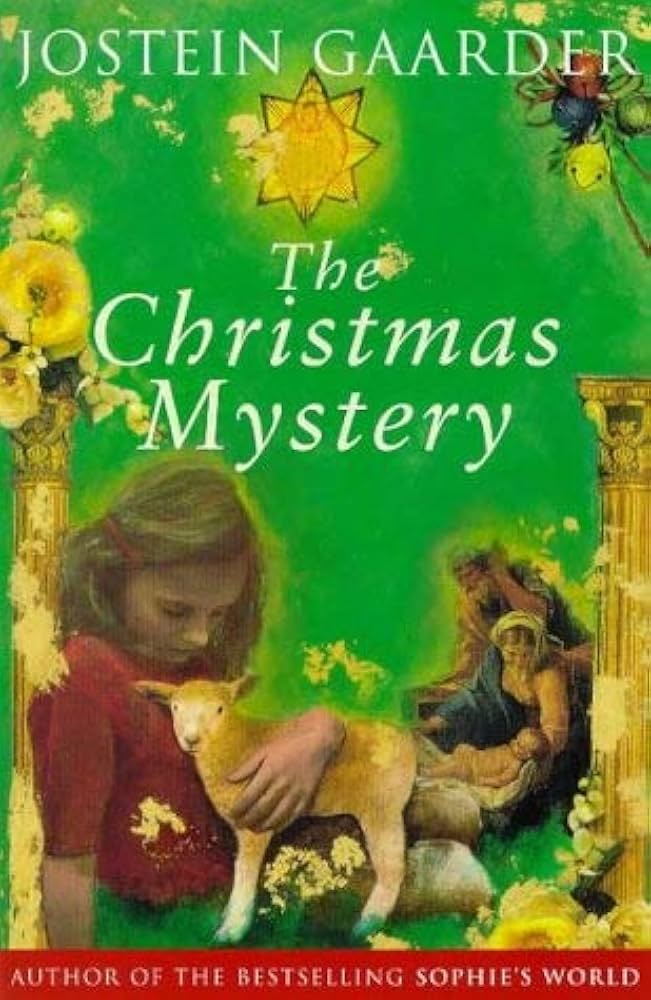
The Christmas story is such an old, old tale that it’s hard to imagine how it can be made fresh again. Jostein Gaarder, author of the philosophical bestseller, Sophie’s World, has managed to do just that.
A young boy, Joachim, finds an old, home-made “Magic Advent Calendar” in a bookshop. On 1st December when Joachim opens the first door, there is a picture and a folded piece of paper containing a story about a young Norwegian girl called Elisabet who is Christmas shopping with her mother when a toy lamb comes to life. On 2nd December there is another picture and another piece of paper, telling how Elisabet chases after the lamb and meets an angel, Ephiriel, who explains the lamb is running to Bethlehem. Day by day a magical story unfolds as Elisabet and Ephiriel travel from Norway through the whole of Europe, and backwards in time, as far as Bethlehem and the birth of Christ.
But Joachim’s father learns that a young girl called Elisabet really did go missing when she was shopping with her mother on Christmas Eve many years ago. So who is the mysterious flower-seller, John, who made the calendar? And what happened to the ‘real’ Elisabet?
In a sense there are three stories in this book: the fantastical tale of Elisabet’s journey; the present day tale of Joachim, John and the girl who disappeared; and the reader’s own interaction: reading a chapter a day (the novel comprises 24 chapters), finding the places on the map, effectively mirroring the actions of Joachim and his parents. You could even argue there is a fourth story, a play within the main tale, as the assorted angels, shepherds, and kings who make the journey to Bethlehem with Elisabet and Ephiriel are told: “Everyone is to take up their places, everyone must remember their lines. We have rehearsed this for almost two thousand years.”
“It’s the middle of the world between Europe, Asia and Africa. It’s in the middle of history at the beginning of our era. Soon it will be the middle of night as well…”
Merry Christmas, everyone!
Rating: ** Worth reading.
 whatcathyread
Thanks so much for the reading blogs, Cathy. Really enjoying th
Ah, thank you!