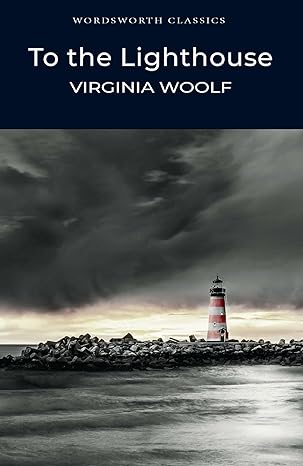
Earlier this year I was on a walk with my friend Hal when he brought up my blog post on Orlando. If you read my post, you might remember I confessed to not liking Woolf’s major novels, Mrs Dalloway (1925), To the Lighthouse (1927) and The Waves (1931). (I did acknowledge I might have been too young to appreciate them properly.) Hal was incredulous I didn’t like To the Lighthouse – so I decided to give it another go.
Perhaps deep down I’d always known I’d return to it someday. After all, my university paperback copy has survived many a book cull and retains its place on my bookshelf, albeit a little tatty and dog-eared. It was odd to open it again and see my forty-year-old annotations and underlining of quotable quotes (‘Mrs Ramsey saying “Life stand still here”’). And as I read, I realized how little I’d retained.
For a start I’d forgotten the novel is set on the Isle of Skye. The story unfolds in three sections. The first section, ‘The Window’, opens with the heroine, Mrs Ramsey, spending summer on Skye with her husband and eight children (yes, eight) plus six assorted guests: Charles Tansley (young academic), Augustus Carmichael (opium-addicted poet), Lily Briscoe (painter), William Bankes (Mr Ramsey’s widowed friend), Minta Doyle (tomboy who Mrs Ramsey has taken under her wing) and Paul Rayley (who Mrs Ramsey is trying to matchmake with Minta).
I’d also forgotten the entire second section of the novel, ‘Time Passes’, which is less than ten percent of the page-count but spans a whopping ten years’ worth of events. Covering the decade between 1910 and 1920, it encompasses the death of Mrs Ramsey’s eldest son, Andrew (in World War One), the marriage of her eldest daughter, Prue, followed swiftly by her death (from complications following childbirth), and the death of Mrs Ramsey herself. How could I forget all that?
Well, possibly because Woolf isn’t interested in those events as such. Mrs Ramsey’s death is dispatched in four lines, Prue’s marriage the same, Prue’s and Andrew’s deaths in three apiece, and all in parentheses. The meat of ‘Time Passes’ is the desertion and dereliction of the Ramsey’s summer house, the abandonment of house and garden to nature and – in the nick time – their reclamation and restoration.
Even the one thing I did remember – that oh-so-quotable quote ‘Mrs Ramsey saying “Life stand still here”’ – I’d misremembered as being said by Mrs. Ramsey rather than by the painter, Lily. This is in the third and final section, ‘The Lighthouse’. Lily returns to the Ramsey’s summer house on Skye to join Mr Ramsey, three of his surviving children and two other guests. She sets up her easel in the garden and tries to finish the painting she started there ten years earlier, when her memory throws up something from that previous holiday: skimming stones on the beach with Paul Rayley while Mrs Ramsey sat on a rock writing letters and laughing. The memory leads Lily to ask herself ‘What is the meaning of life? That was all – a simple question; one that tended to close in on one with the years.’
A simple question? Wow!
Then Lily has an epiphany: probably there is no answer. Instead of looking for a ‘great revelation’ we should cherish the ‘little daily miracles[…]matches struck unexpectedly in the dark,’ like that day on the beach, for instance. Mrs Ramsey’s skill at bringing people together created memories – you can fill in the quote for yourselves by now – and in doing so she was ‘making of the moment something permanent (as in another sphere Lily tried to make of the moment something permanent)’.
That’s why the setting on Skye is so important. Nowadays, Skye is attached to the Scottish mainland by a road bridge but then it was still a ‘true’ island, its inhabitants at the mercy of the weather and the tides, forces that can’t be controlled or delayed and are indifferent to human desires and actions. But Mrs Ramsey and Lily both work (in their own ways) to impose ‘shape’ on ‘chaos’ and create ‘stability’ in spite of ‘external passing and flowing’.
Earlier, I described Mrs Ramsey as the heroine. You could argue it’s Lily, though. At least, I imagine Woolf would have identified more with Lily, the independent female artist, grappling to fill a ‘glaring, hideously difficult white space’ than with Mrs Ramsey, beautiful, manipulative, family-focused and, incidentally, not even given a Christian name.
By now you might have realized that not a lot happens. You could actually sum up the plot in a single sentence: the Ramsey’s youngest son, six-year-old James, wants to sail to the Lighthouse but the weather is too bad to make the trip, and ten years later he eventually sails there with his father and sister. OK, I’m being mean. The Lighthouse symbolises…what? Longing (for James, certainly), permanence (the Lighthouse beam entering the rooms of the Ramsey’s abandoned summer house), closure (‘it is finished’ says Lily aloud as she watches Ramsey and his children reach the Lighthouse, echoed shortly after by ‘it was finished’ as she completes her painting). But it’s fair to say if you value action over introspection, possibly this isn’t the book for you.
And if I’m being picky, it does show its age (and not only because of the Skye bridge). Six-year-old James hates his father for interrupting ‘the perfect simplicity[…]of his relations with his mother’; sixteen-year-old James still nurses hatred and a murderous rage towards Mr Ramsey. (‘I shall take a knife and strike him to the heart.’). Oedipus complex^ anyone? Freud’s seminal work The Interpretation of Dreams was less than thirty years old when To the Lighthouse was published, and psychoanalysis was still a relatively new science, so perhaps we can forgive Woolf’s clunky shoehorning of his theory into the narrative.
Overall, though, To the Lighthouse was a lot more engaging than I remembered. I guess I was right about being too young the first time around; its main theme, the passage of time, is more relatable the older you get. So thanks, Hal, for giving me the nudge I needed to reread it. You never know, I might even be persuaded to dust off my copy of Mrs Dalloway!
Rating: ** Worth reading
^ Freud used the term for the first time in his paper “A Special Type of Choice of Object Made by Men” (1910), but he had set out the general concept of a son’s sexual attitude towards his mother and concomitant hostility toward his father twenty years earlier in his book The Interpretation of Dreams (1899).
 whatcathyread
2 thoughts on “To the Lighthouse by Virginia Woolf”