When I was a little girl, my mum used to sing me to sleep at night, mostly with popular songs from the 1920s – 1940s. (I know a ridiculous number of songs by Cole Porter, Gene Autry and The Andrews Sisters for someone my age.) One bedtime favourite was ‘Ol’ Man River’ from the musical Show Boat, famously sung by Paul Robeson.
Not that I knew it at the time but as I was drifting off to his iconic song Robeson was living his final years in virtual seclusion. One of the most famous men in America – certainly the most famous black man – he’d been blacklisted for his political views in the 1950’s (during the McCarthy “witch hunt” era); his recordings and films were removed from public distribution in the US, his passport was voided; his career was effectively destroyed.
And I mention this because Paul Robeson makes a fleeting appearance in I Married a Communist. It is 1948, at a rally in support of Henry Wallace’s bid for the US Presidency, and Robeson shakes hands backstage with the narrator, Nathan Zuckerman. ‘Standing backstage with the performers and speakers at the Mosque – enveloped simultaneously in the two exotic new worlds, the leftist milieu and the world of “the wings” – was as thrilling as it would have been to sit down in the dugout with the players at a major league game.’
In the story, Nathan has been introduced to Robeson by Ira Ringold, aka the radio star Iron Rinn, who he knows through his high school English teacher, Ira’s younger brother, Murray. Ira, impressed by Nathan’s convictions, takes the star-struck teenager under his wing almost as if he were his son. He takes him to the Wallace rally and invites him into his home; he influences his political thinking and encourages his writing aspirations (both heavy on polemic and ‘the lot of the common man’).
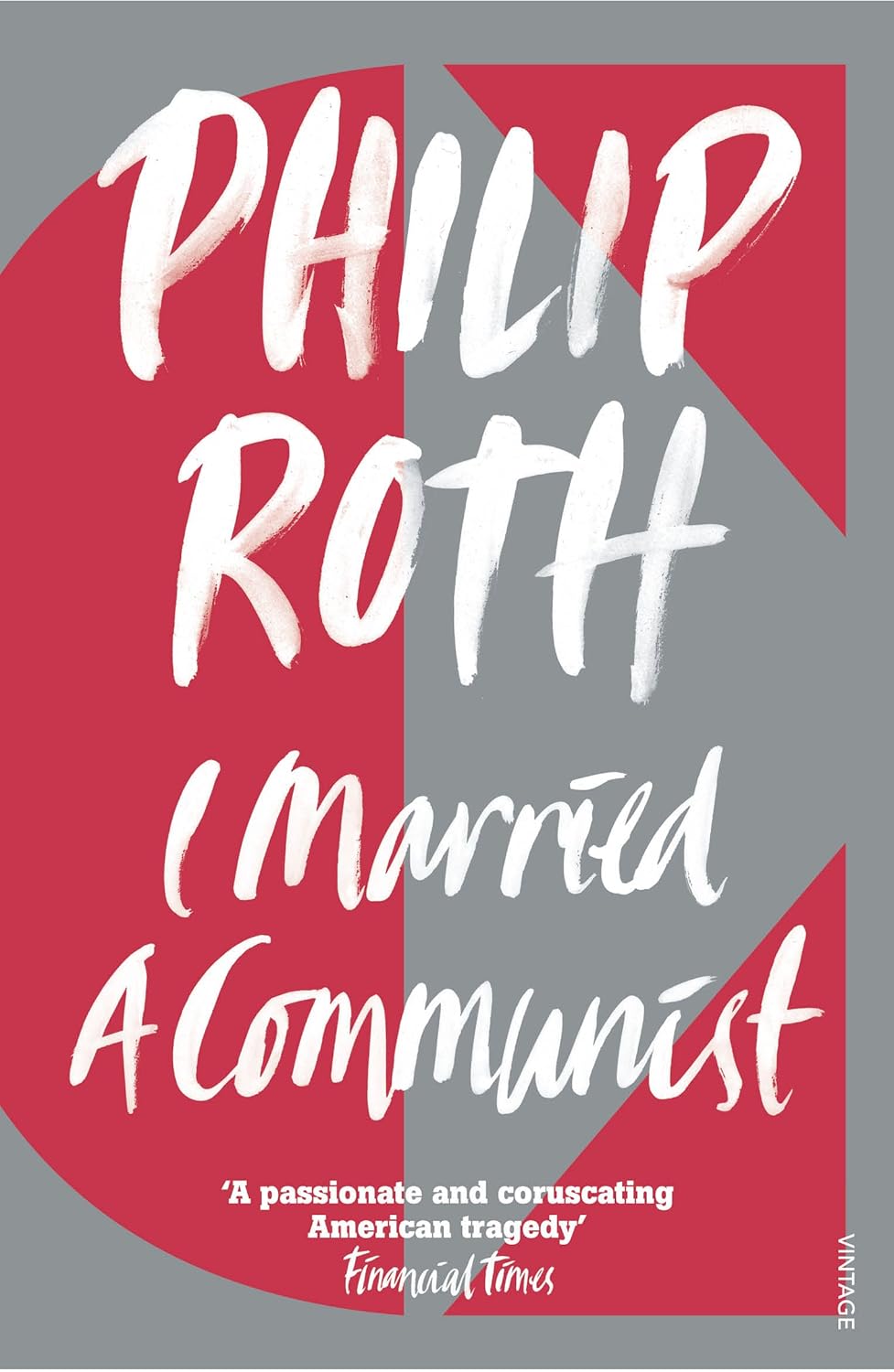
When Nathan moves away to study at University of Chicago, Ira’s influence begins to wane. A few years later, in 1951, at the start of Nathan’s second year at Chicago, Ira is “outed” as a Communist and fired from his radio show. Then comes the final nail in Ira’s coffin: the bestselling expose written by Ira’s estranged wife, former Hollywood star now theatrical leading-lady Eve Frame, entitled “I Married A Communist”.
Forty years later, Nathan bumps into his old English teacher, Murray. Over six nights Murray, now ninety, tells Nathan ‘everything I didn’t know and couldn’t have known about his brother’s private life.’
I Married A Communist is the second book in Roth’s American Trilogy (the first was American Pastoral, which won the Pulitzer Prize in 1998 – you can read my review of it here). Both have the same narrator (Nathan Zuckerman) and, as before, Roth uses the device of a story within a story (or a story within a story within a story, if you count Eve Frame’s book). This time around the basic logistics on which that framing hangs – teenage Nathan meeting Ira, adult Nathan bumping into Murray – seem rather contrived. That doesn’t take anything away from the novel, though. It’s an intriguing take on a period when anti-Communist fervour possessed American national politics and spilled over into family life.
More, though, it explores the meaning and place of literature as an art form. Take this, for example: ‘Generalizing suffering: there is Communism. Particularizing suffering: there is literature. […] You do not have to write to legitimize Communism, and you do not have to write to legitimize capitalism. You are out of both. If you are a writer you are as unallied to the one as you are to the other. Yes, you see differences, and of course you see that this shit is a little better than that shit, or that that shit is a little better than this shit. Maybe much better. But you see the shit.”
Roth won the Man International Booker in 2011 (when it was a biennial prize for a body of work rather than an annual award for an individual book written in a language other than English, as it is now). The final book in his American trilogy, The Human Stain, is nearing the top of my “to read” pile.
Rating: **** One of the best books I’ve read this year.
 whatcathyread