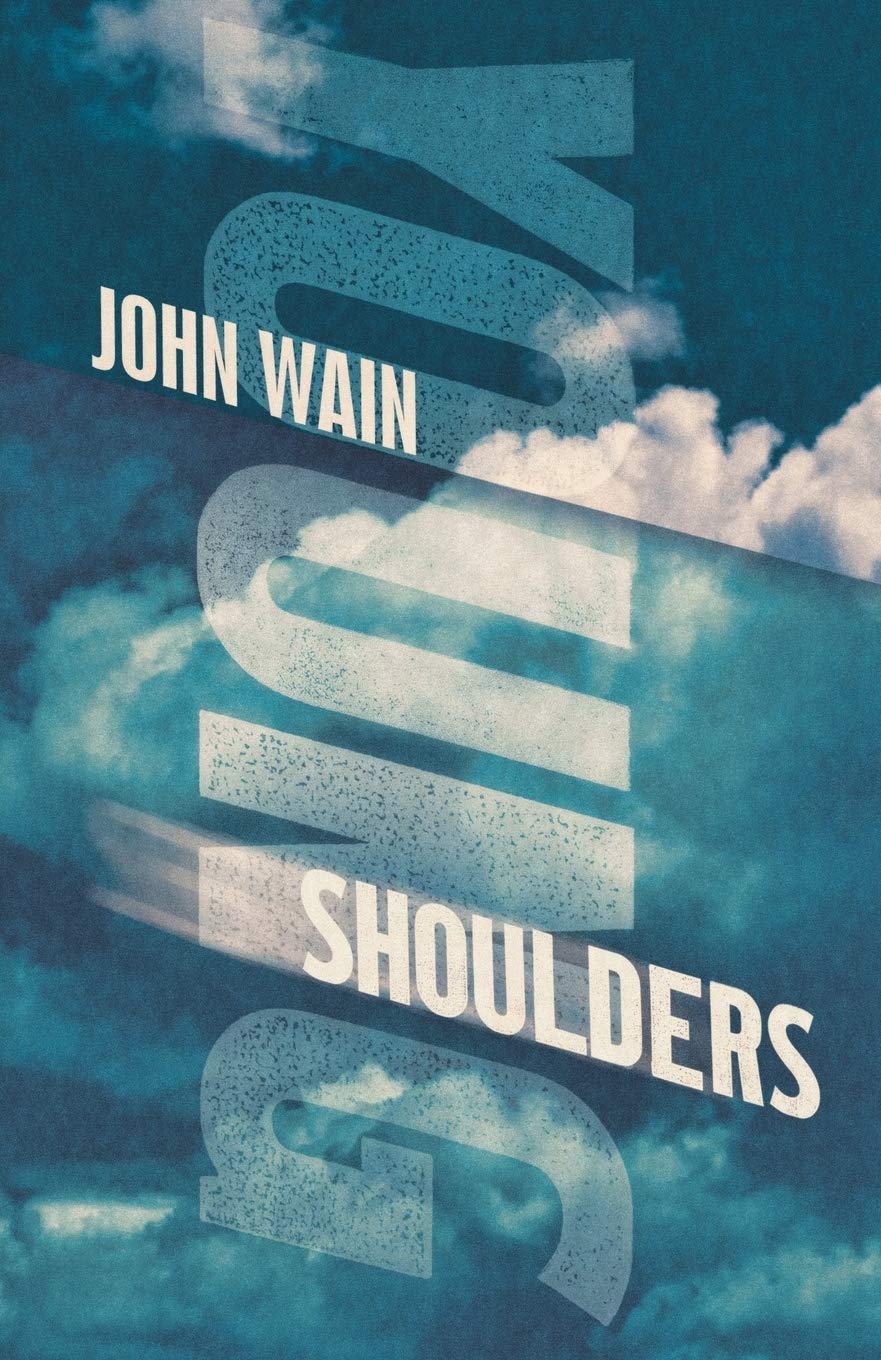
Earlier this year I visited Ljubljana and Lake Bled on a solo short break, travelling with only a small carry-on rucksack meeting Easyjet’s under-seat size rules. So I had to be strict about what I took and when it came to selecting a book for the journey from my to-read pile – I’m old school, see; still buy paper copies – I chose the slimmest volume on the pile, which happened to be Young Shoulders by John Wain.
(It was only at the airport, as I read the blurb on the back cover [‘Why did his young sister have to die in an air disaster?’], that I realised this particular novel perhaps wasn’t the best choice of reading matter for a plane journey, but hey ho.)
Seventeen-year-old Paul Waterford’s young sister, Clare, has died in a plane accident while on a school trip. Paul, together with his parents, Ben and Martha, the parents of the other dead children, the widow of a teacher who also died in the crash, and the school’s Headmaster are being flown to Lisbon, the ill-fated plane’s departure point, for a memorial service.
The story unfolds over twenty-four hours, starting with Paul’s Dad driving to the airport, then the flight out, lunch at the hotel, the service, back to the hotel for dinner, evening in Lisbon, flight home again the next morning. It sounds prosaic when you put it like that but a lot happens during the trip both externally and (more importantly) in the internal journeys of Paul and Martha.
Events are narrated in the first person from Paul’s perspective, with each “traditional” narrative chapter followed by a ‘report to Clare’. You see, during the outbound flight Paul feels Clare is present ‘Close to me somewhere. Waiting for me to talk to you. And that’s what I want to do […]’ He talks silently to Clare about their parents’ fragile marriage (although ‘I’m quite sure […] that you know, now, just how things are’) and about Martha’s drink problem (‘it was perfectly obvious […] to an older kid, that she’d collapsed into bed at eight o’clock because she’d been steadily soaking up whisky since about lunch-time’). Then he confides to Clare his plan to become the Founder of an ideal community called the World Free Zone: ‘There won’t be any of the God-awful family life that we’ve had to go through, children’ll be looked after communally.’
It’s a childish fantasy, of course, born from the wish that ‘nobody will live the sort of life Mother and Dad live, making each other unhappy and spreading that unhappiness all through the house they live in.’ But his experiences that night in Lisbon, and what unfolds at the airport the next day, make Paul see things very differently.
Young Shoulders is a sweet, coming-of-age story that tackles some pretty heavy issues (the sudden loss of a child, the breakdown of a marriage, alcohol abuse) with a lightness of touch that is neither trivial nor depressing; in fact the ending feels very hopeful.
I did spot a couple of errors that really should have been picked up before publication: in Chapter Three Mr Smithson (another parent) is called Howard by his wife but in the Seventh report to Clare, his wife calls him Jim; and in the same Report, Paul tells Clare about Mother having a whisky on the plane home, only to tell her a few pages later that Mother hadn’t had a drink on the plane. Still, that’s down to the editor as much as the author and the errors didn’t detract from the overall story.
Young Shoulders won the Whitbread Novel Award (the precursor to the Costa Awards) in 1982.
Rating: *** Highly recommended – although perhaps not on a plane.
PS I can’t resist mentioning that in Chapter One John Wain name-checks the iconic actor whose name he shares (albeit a homophone). ‘Help has arrived, the United States Cavalry, John Wayne, Burt Lancaster, it’s all happening.’ Love it!

