To my knowledge, I’ve only met one South African (well, two, if you count her mother). We were neighbours for a while. I didn’t know her well but shared her company enough to hear reminiscences about school holidays spent camping in the bush, learning bushcraft, hiking and braaing (barbecuing). Swimming in the Irish Sea didn’t phase her. The sea in Cape Town, she once told me, is rougher, more unpredictable, and often just as cold; it was there she’d learnt to move through crashing waves by duck-diving under them. (She once tried to teach me how but I mistimed my effort and met the full force of the wash with my head. Ouch!) She was outdoorsy, fun, and mad as a box of frogs.
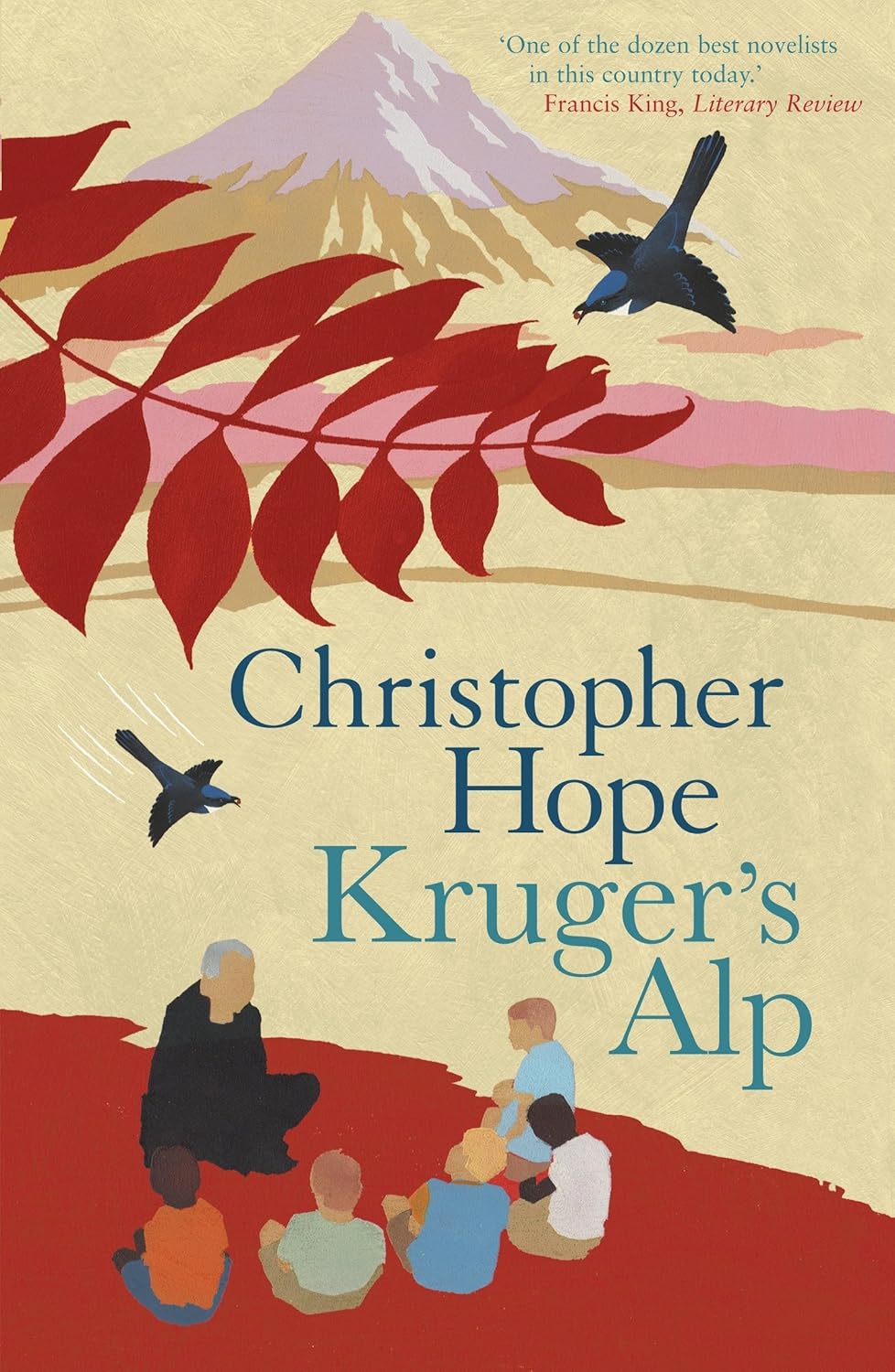
Christopher Hope’s prize winning novel, Kruger’s Alp, displays the same chaotic energy as my erstwhile neighbour. Set variously in South Africa, London and Switzerland, we follow Theodore Blanchaille (aka Blanchie) as he searches for the legendary Kruger Millions, a vast treasure of gold reportedly smuggled out by President Paul Kruger when he went into exile. ^
Or rather, we don’t follow him. You see, the book opens with an unnamed narrator lying down under a tree in the garden of a partially demolished church (‘ours is a holy land and even the destruction of redundant churches halts on the Sabbath’). The narrator falls asleep and the entire story that follows is the narrator’s dream.
And we’re never allowed to forget it’s a dream. The opening line of Chapter 2 is ‘And when in my dream I saw’, Chapter 3 opens with ‘Now in my dream I saw’, Chapter 4 with ‘And now I saw in my dream’. In all, the first lines of eleven of the twenty-five chapters directly signpost the dream – and that’s not counting the other references to the dream within the text. So why is it so important we remember it’s a dream?
Well, it’s a technique (obvs), and it isn’t new. The dream-vison might not be a ‘thing’ in literature nowadays but it was once the go-to genre, arguably reaching peak-popularity in medieval times. Chaucer used it, as did Bunyan and Langland.~ You see, a dream is a space that allows for – even invites – the bizarre. Things that wouldn’t hang together in the waking world make sense in the context of a dream. A dream, in short, means anything goes.
Yet a dream is also a space for truth, where the dreamer can resolve inner turmoil and gain insight into complex ideas. In Hope’s gifted hands, it turns out the dream-vision is perfect for satirising the greed, corruption, hypocrisy and madness of the South African government during the apartheid regime.
Hope, to his credit, respects the genre. Dream-visions typically contain a dream-guide. In Kruger’s Alp, it’s Father Ignatius Lynch, a ‘small, thin and elfish’ Irish priest ‘who never understood Africa, or perhaps understood it too well.’ Whatever surreal events, bizarre characters and absurdist landscapes Blanchie comes up against (and there are many) Father Lynch pops up to help him reach his goal: Kruger’s lost City of Gold.
(In a clever interplay between the waking world and the dreamscape, Father Lynch used to be Parish Priest of the soon-to-be-demolished church where the narrator is taking a nap.)
The story ends when the dreamer wakes up. Not a spoiler, simply what’s expected, like a dream-guide, within the dream-vision framework. And what has our dreamer / narrator learned from the dream? ‘[…] I realised it’s a long way down at the best of times and that the pit may wait at the end of the American rainbow, or open beneath the feet in some seeming Swiss paradise just as surely as it does in the city of destruction where I was born’.
Hope wrote Kruger’s Alp in 1984, ten years before apartheid officially ended. It won the Whitbread Novel Award the same year. If you like black humour, fantastical violence, comic-book characters (secret policeman, spy, exiled minister, terrorist etc.) and political satire – think Reservoir Dogs meets Spitting Image – this could be the book for you. A quick tip, though: it might be worth jotting down at least the names and occupations of the former altar boys of Father Lynch; I found myself having to look back at certain points in the ‘dream’ to refresh my memory about who was who and what was what.
Rating: *** Highly recommended
^Paul Kruger was President of the South African Republic (the Transvaal) from 1883 to 1900. His resistance to British expansion triggered the Second Boer War (1899 to 1902). As the war turned against the Boers, Kruger fled to Europe and the concomitant story of missing / hidden gold remains one of South Africa’s most enduring (and contested) legends. Kruger’s name lives on in the wildlife reserve he established, Kruger National Park, and in the gold coin, the Krugerrand.
~Notable medieval works using the dream vision include Chaucer’s Parliament of Fowls, Langland’s Piers Plowman, and Bunyan’s The Pilgrim’s Progress.

