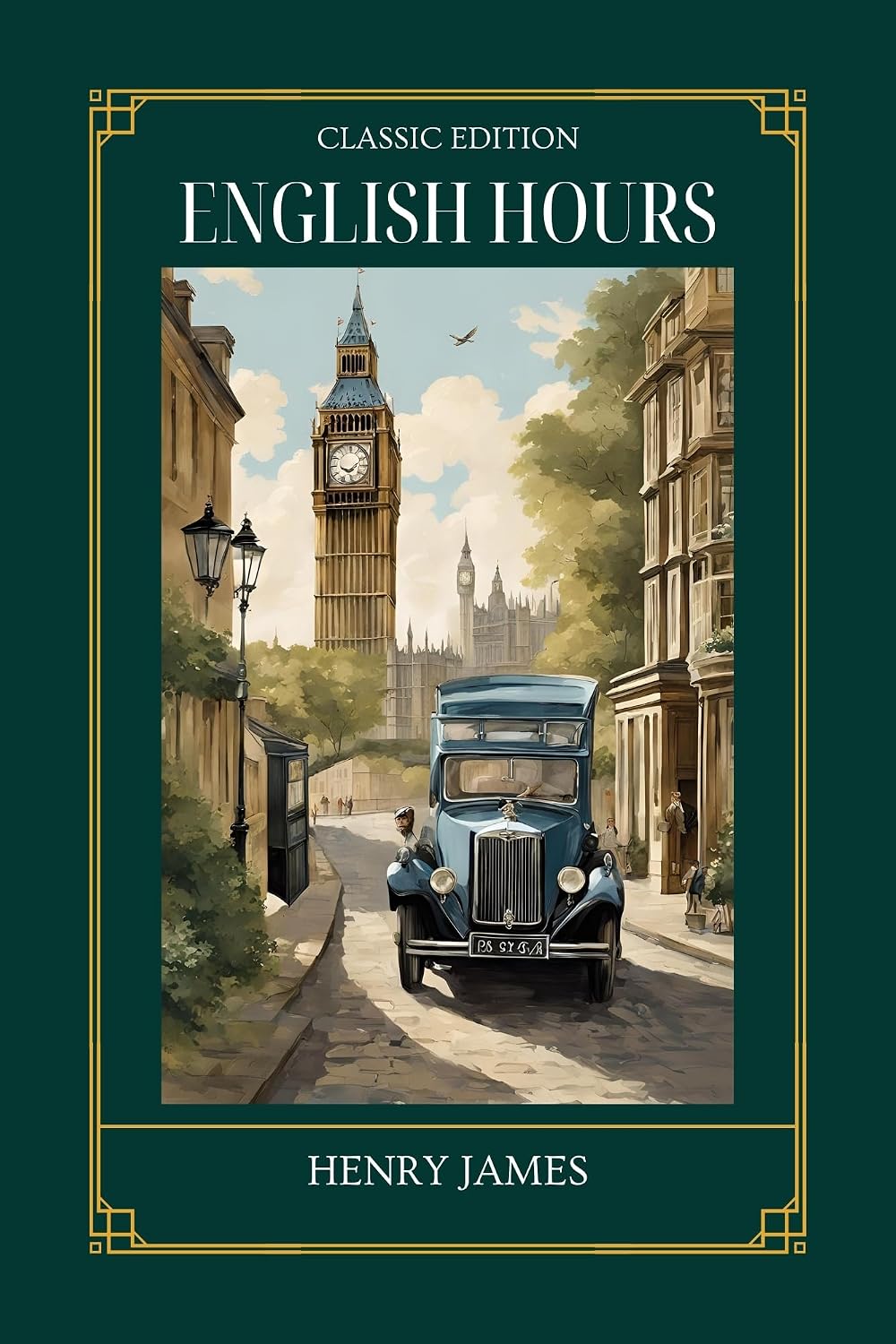
It’s my sister’s fault I read this book. Ok, ok (in my head I can hear her protesting) that’s not really true. She bought me the Bedside Companion for Travel Lovers, an extract-a-day-for-a-year anthology of travel writing, or, more accurately, any genre of writing about something travel-related (places, people, transport). The extract for 1 March (headed ‘Arrival’) was from English Hours. It concerns Henry James’s arrival in Liverpool – my home city – and touches on his breakfasting in ‘the old coffee-room of […] the unimproved, the unblushing local’ Adelphi Hotel. I was hooked. I knew I had to read the whole book.
Part of the attraction was James himself. An American and a self-proclaimed Europhile, I’d read a couple of his novels at Uni, Daisy Miller (1879) and Portrait of a Lady (1881), and knew some of his other works by repute, his novel The Ambassadors (1903), for example,and his ghost story, The Turn of the Screw (1898). I knew he’d settled in England and eventually became an English citizen; I knew from the two novels I’d read that he had an astute take on Anglo-American cultural misunderstandings. But his travel writing was unknown to me.
Unfortunately my enthusiasm for reading English Hours had waned by the time it reached the top of my to-read pile. It turns out my curiousity about visitor attractions in late 19th century England had a short shelf-life (who knew?).
It also turns out English Hours isn’t a traditional travelogue: it’s really a series of sketches or impressions of James’s various jaunts around the country between 1872 and 1890. He writes about his arrival (by boat, of course, disembarking in Liverpool i.e. the extract that reeled me in), and visits to Chester, Oxford, Cambridge, the Isle of Wight, Hastings, and more, but many of the sketches are London-centric – understandable since James lived there for more than twenty years but not what I was expecting.
And James expects his readers to work. It’s not like he can’t be punchy: ‘Cambridgeshire is one of the so-called ugly counties; which means it is observably flat’ or ‘The Isle of Wight is at first disappointing’ or ‘It was probably a mistake to stop at Portsmouth’. Ouch! But then there’s stuff like this in the ‘Old Suffolk’ section: ‘We doubtless gather another indeed that will serve as well any such turn as here may wait for it; so that if it was somehow not easy to work Fitzgerald into the small gentility of the seafront, the little “marina,” as of a fourth-rate watering-place, that has elbowed away, evidently in recent years, the old handful of character, one could at least, to make up for that, fall back either on the general sense of happy trickery of genius or on the special beauty of the mixture, in the singer of Omar Khayyam, that, giving him such a place for a setting, could yet feed his fancy so full.’ What????
There were sections that held my interest for sure, and my ‘Classic Edition’ paperback included some lovely original illustrations, which were an unexpected bonus. In retrospect, though, I’d have been better revisiting James’s fiction. If you’re a fan of travel writing, English Hours might be worth a shot – but be prepared to buckle up and engage your brain.
Rating: * Not for me (but worth a try)

