If you stepped back three decades (almost) to summer 1998, you’d find ‘a president’s penis was on everyone’s mind’. The President was, of course, Bill Clinton, and the detail emerging about his sexual shenanigans with twenty-two-year-old White House intern Monica Lewinski, a women less than half his age, was sending America into an ‘ecstasy of sanctimony.’
That same summer, against the backdrop of the Clinton-Lewinski scandal, former classics professor, seventy-one-year-old Coleman Silk, confides to his neighbour, writer Nathan Zukerman, that he’s having an affair with a thirty-five-year-old woman, Faunia Farley, who works as a janitor at his old college, Athena. Woman half his age? Check. Same workplace? Check. The parallels are clear.
Except Coleman Silk is no longer a powerful man. For sixteen years he’d been dean of faculty, ‘the first and only Jew ever’ at Athena to hold the position. But two years before his affair with Faunia, he’d left Athena under a cloud. His offence? Referring to two students who’d been total no-shows for the first five weeks of term as ‘spooks’. The two students, who were black, accuse him of racism. Coleman insists he was ‘using the word in its customary and primary meaning […] as a specter or a ghost’ and that he had ‘no idea what color these two students might be’. But as a get-things-done dean he’s made a fair few enemies in the faculty and consequently lots of his colleagues are pleased the word he used was ‘definable not only by the primary dictionary meaning […] but by the pejorative racial meaning.’~
Coleman flips his lid and resigns, turning up at Nathan’s house and all but ordering him to write a book about his mistreatment. (“Thrown out of Athena [he tells Nathan] for being a white Jew of the sort those ignorant bastards call the enemy.”) Nathan declines and Coleman sets out to write his own book entitled – predictably – Spooks. It takes Coleman two years to write the first draft (until summer 1998, where the novel starts) then he abruptly ditches the project (“it’s shit and I’m over it”). After all, he has ‘ignitable’ Faunia, now (‘she’s turned sex into vice again).
But Coleman’s life is about to get complicated again. Faunia has a Nam-Vet PTSD-afflicted abusive ex. And the Coleman-obsessed French academic, Delphine Roux, is also taking an interest in the relationship.
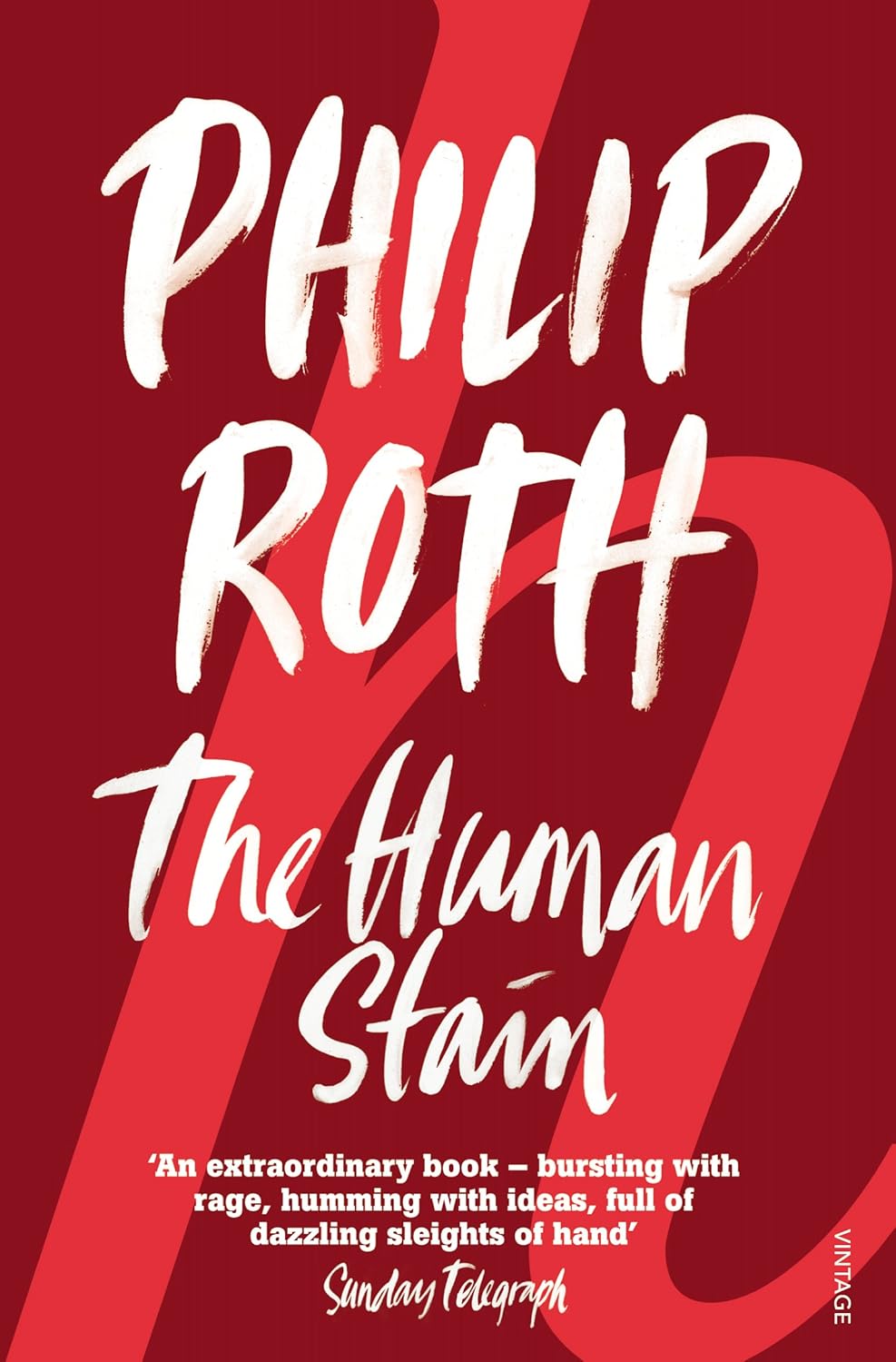
After Coleman’s death (not a spoiler) Nathan writes The Human Stain about Coleman, the book that Coleman asked him to write – but possibly not the book that Coleman would have wanted written. You see after Coleman’s death, Nathan discovers that Coleman had a secret, a biggie, more than fifty years in the making. The Human Stain is the result of Nathan reconstructing the facts of Coleman’s life and imaginatively recreating the bits he doesn’t know. Yes, it’s meta. But above all, it’s an masterful exploration of identity, self-determinism, and the complexity of being human.
This is the final book in Roth’s American Trilogy (following American Pastoral and I Married A Communist both of which I’ve reviewed in previous blog posts). Roth won the Pulitzer Prize in 1998 for American Pastoral and the Man International Booker in 2011 when it was a biennial prize for a body of work (rather than an annual award for an individual book written in a language other than English, as it is now).
Rating: **** One of the best books I’ve read this year
~ This was a new one on me. In the UK, the slang / secondary meaning of ‘spook’ is a spy. But apparently in the US it was a racial slur that gained prominence in the WW2 era. From Google, the slur began when black Army pilots were mocked as ‘Spookwaffe’ based on the idea that black people wouldn’t be seen in the dark, like ghosts. Which doesn’t even make sense because surely ghost sightings are associated with nighttime? Aren’t they? So logically it would be the white pilots, not the black ones, who were ‘Spookwaffe’. But, hey, whenever were logic and racism natural bedfellows?

