The main reason for writing about books is to help me remember them. It doesn’t always work. Another reason is that sometimes the act of writing unlocks something about the book that hadn’t occurred to me before. More on that later…
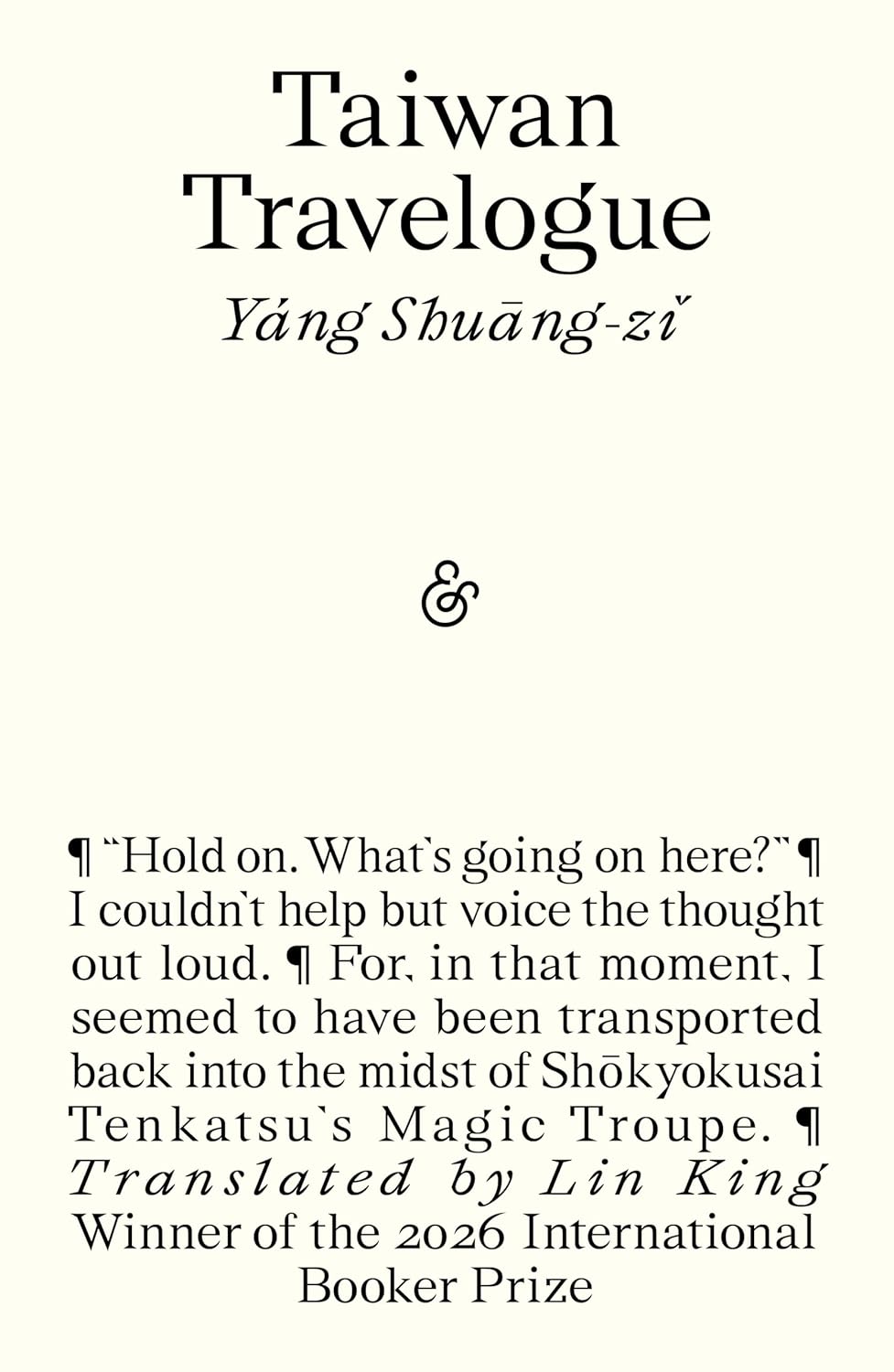
There’s one thing about Taiwan Travelogue you should know from the outset: it isn’t a travelogue.
Taiwan Travelogue is a Taiwanese novel published in 2020 pretending to be a new translation into Mandarin Chinese of a rediscovered memoir / novel by a Japanese writer called Aoyama Chizuko, that was first published in 1954. In other words, it’s fiction masquerading as memoir.
The pseudo-memoir sub-genre has a long history, going all the way back to Robinson Crusoe (1719), which was held out on first publication as a travel log written by a real castaway ‘Robinson Crusoe, of York, Mariner,’ with the actual author, Daniel Defoe, credited as ‘the Editor of this Account.’ Roll forward to the twenty-first century, and Taiwan Travelogue isn’t even the first of its kind to be awarded a prize by the Booker Committee. The True History of the Kelly Gang by Peter Carey (2000) is framed as a collection of loose papers written by the real Australian bush-ranger, Ned Kelly, to his daughter; and The Testaments by Margaret Atwood (2019) is framed as historical record, comprising transcripts of two witness testimonies (witness 279A and witness 279B) and a contemporaneous Gilead manuscript The Ardua Hall Holograph.
Pseudo-memoirs, though, generally don’t involve pseudo-translation. Why complicate the conceit by pretending to discover/rediscover a foreign-language work rather than one in your own language? Well, in Taiwan Travelogue’s case, it makes for a subtle exploration of the power imbalance between the island’s Japanese colonisers and the colonised islanders.
Taiwan’s Japanese colonisers? Yep. I’ve always thought of Taiwan in relation to China, but between 1895 and 1945 Taiwan was part of the Japanese Empire. TT is set in 1938 / 1939, when Taiwan was still governed by Japan.
Nagasaki-based author, Aoyama Chizuko, is invited on an all-expenses-paid twelve month lecture tour of Taiwan. On arrival she refers to ‘the Taiwanese’ and is immediately corrected, ‘do you mean the Islanders?’ You see, Taiwan has been ‘received’ by the Empire. It isn’t regarded as a nation. The people who live there are either ‘Mainlanders’ i.e. from Japan or of Japanese descent, or ‘Islanders’, a catch-all term for the majority of the population. Mainlanders and Islanders go to different schools, they eat different food.
Aoyama, a self-confessed ‘glutton’ with a ‘monster’ appetite, wants to try ‘all those Islander foods.’ With an Islander interpreter, Ong Tshian-hoh or ‘O Chizuru in Japanese’ (‘a petite young woman who came up to around my jaw’), Aoyama travels around Taiwan and gorges herself on the local cuisine, some bought on their travels, some cooked by O Chizuru. Together, they eat their way around Taiwan.
Obsessed as she is about food, Aoyama is also obsessed with O Chizuru. She says they were fated to meet, calls Chizuru her ‘angel’ and ‘omnipotent’, gives her the nickname ‘Chi-chan’ (based on her Japanese name) instead of using her ‘proper’ name, and insists ‘I must have you as a friend.’
The desire to be friends, the insistence that they are friends, is expressed by Aoyama many times. At first Chi-chan’s reply is only a dimpled smile, ‘like a Noh mask. Inscrutable.’ When Chi-chan eventually ventures that ‘Friendships are between equals, are they not?’, Aoyama cuts her off. She refuses to listen.
There are intimations that Aoyama’s feelings for Chi-Chan might be more than platonic – for example ‘Her dimples looked as sweet as though they were made from honey. I felt almost faint.’. That said, it’s never made explicit.
If I have one gripe about TT, it’s the food. Food gives the book its structure, with every chapter named after a new food experience: Chapter 1 Kue-Tsi / Roasted Seeds, Chapter 2 Bi-Thai-Bak / Silver Needle Vermicelli, Chapter 3 Mua-Inn-Thng / Jute Soup, etc. Sure, each menu item is a symbol of the unique cultures of the island. Moreover – which only dawned on me while writing – Aoyama’s voracious appetite can be read as a metaphor for colonialism. But the descriptions, particularly around preparation and cooking, can be very detailed, very granular. If you’re into recipe books and Kitchen Cabinet, that might be a good thing. I’m not. The first few chapters, I rolled with it. By chapter five, I found myself skim reading the food passages.
Overall, though, TT is a sweet, or rather, a bitter-sweet book. Aoyama / Japan might mean well and want the best for Chi-Chan / Taiwan, but she learns you can’t make someone love you and if you think you know best ‘even assistance offered out of goodwill is simply another form of arrogance.’ By the way it’s not lost on me or on the translator, Lin King, that her Mandarin-to-English translation brings the book ‘to the ultimate colonial language.’ And I don’t believe it’s chance that Aoyama hails from Nagasaki. We all know what happened there.
Taiwan Travelogue was the winner of the 2026 International Booker Prize.
Rating: *** Highly recommended.

